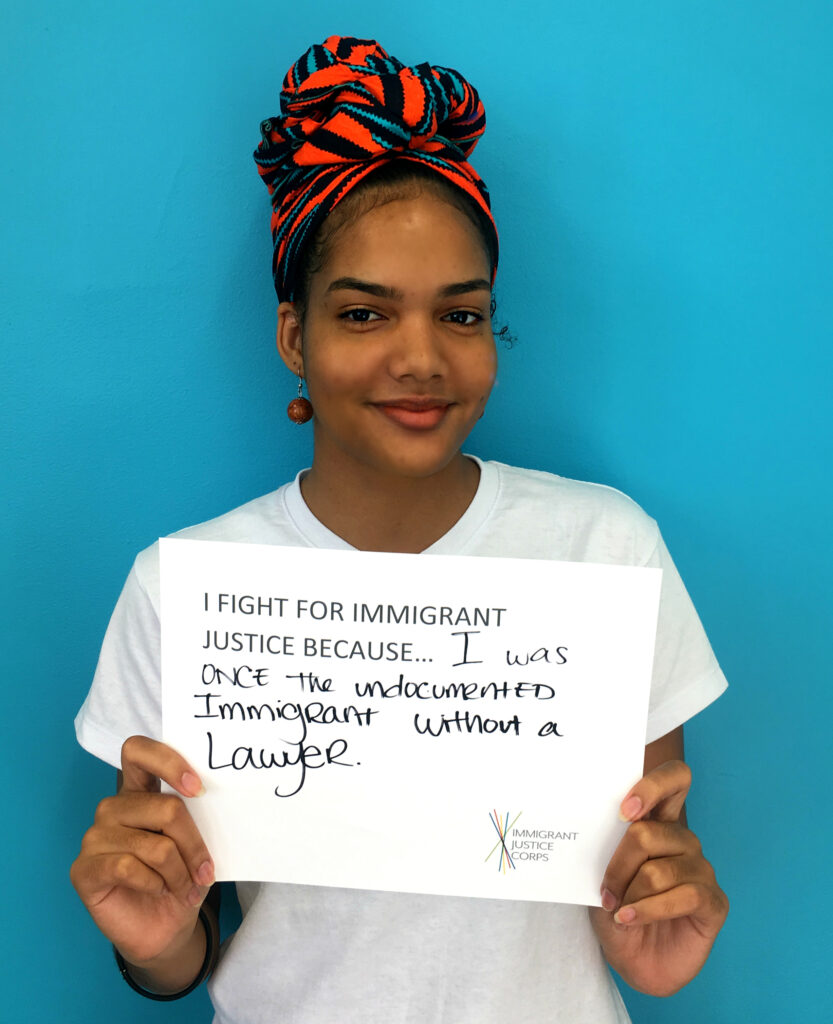
"Campaigns of cruelty" - Alycia Jameson

Over the past 18 months, ICE operations have expanded across the country as the administration pushes for mass deportations. Large-scale enforcement efforts have left communities fractured and scared.
For many of our Fellows, these operations have been in their own communities, in Minneapolis, New Orleans and others. We asked four of our Fellows to share their experiences working through these operations, the impact the ICE presence had on their work and clients, and what they have taken away from the past year and a half.
Alycia Jameson, a 2025 Justice Fellow working at The Resurrection Project in Chicago, Illinois, shares the story of a client who was detained during Operation Midway Blitz. Alycia is a graduate of the University of Arkansas Little Rock William H. Bowen School of Law.
During Operation Midway Blitz in Chicago, one of my first clients was abducted by ICE while simply standing outside of a Home Depot. From that moment on, her constitutional rights were violated. She was detained without probable cause or a warrant, handcuffed behind a building for hours, and interrogated by masked officers.
Despite the chaos and fear of that moment, she knew her rights because of prior community education efforts. She remained silent and asked for an attorney. At the time, she didn’t realize how critical that decision would be—but her insistence on exercising her rights may have ultimately saved her case.
After being processed by ICE, she was transferred out of state to a detention center in Kentucky. From there, she managed to contact a friend, who then called a hotline for families of detained individuals run by Illinois-based organizations, including The Resurrection Project. That is how her case came to me.
It was immediately clear that she was exceptionally vulnerable in this system. She had very limited support on the outside and had been living in a shelter prior to her detention. There was no realistic way she could have afforded an attorney. Learning the details of her arrest was terrifying and deeply frustrating because it blatantly contradicted the fundamental Fourth Amendment principles we are taught in law school.
I challenged her arrest in immigration court by filing a motion to suppress all evidence obtained as a result of the unlawful arrest, including evidence of alienage. Initially, we succeeded. The immigration judge granted the motion and terminated proceedings. But despite that victory, she remained detained by ICE.
Through collaboration with partner organizations, we were able to secure pro bono counsel to file a habeas petition in federal district court seeking her release. Although the immigration judge later granted DHS’s motion to reconsider and reopened proceedings, that brief window was enough. During that time, the federal district court granted the habeas petition and ordered her immediate release, recognizing the constitutional violations she had endured.
With the help of an incredible network of volunteers in Kentucky, we were able to bring her safely back to Chicago after over 100 days in detention. Her case has since been transferred, and while her immigration proceedings continue, she is no longer detained and now has a meaningful opportunity to pursue relief.
The day she was released is something I will never forget. Getting the call—“Abogada, ya salí!”—is a moment that stays with me. It’s the feeling I return to, especially on the harder days, when the losses feel heavy.