"Campaigns of cruelty" - Perry Keziah

Over the past 18 months, ICE operations have expanded across the country as the administration pushes for mass deportations. Large-scale enforcement efforts have left communities fractured and scared.
For many of our Fellows, these operations have been in their own communities, in Minneapolis, New Orleans and others. We asked four of our Fellows to share their experiences working through these operations, the impact the ICE presence had on their work and clients, and what they have taken away from the past year and a half.
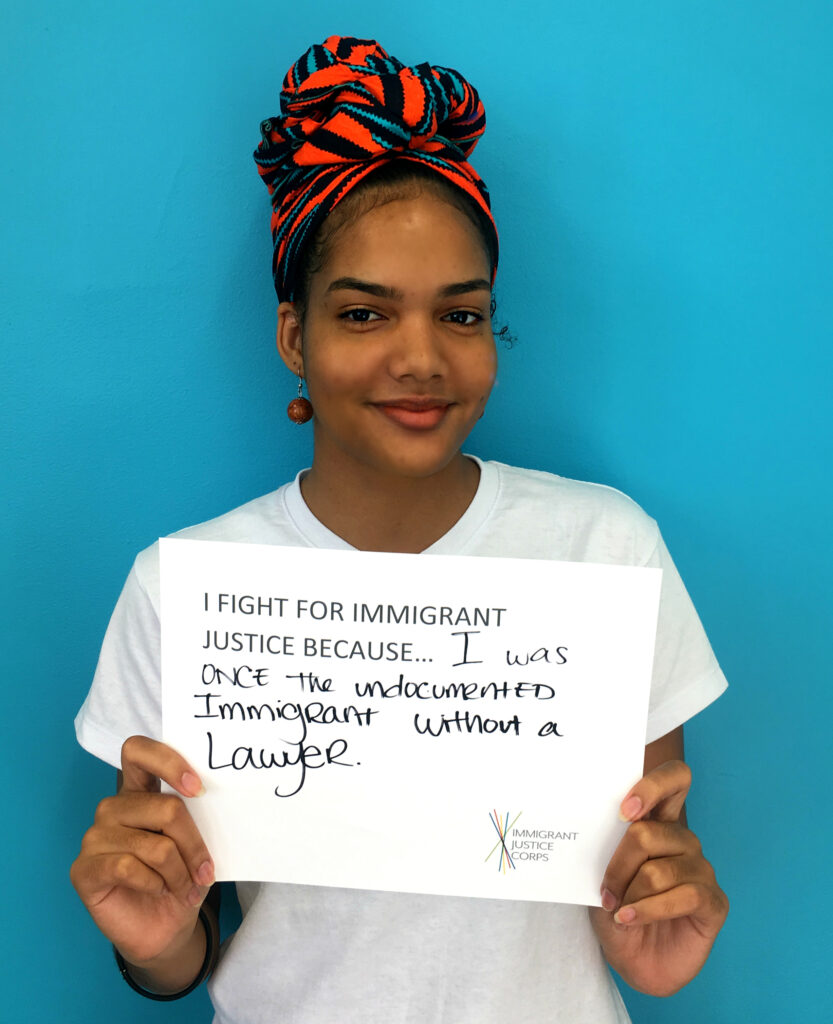
Perry Keziah, a 2025 Justice Fellow working at Mid-Minnesota Legal Aid in Minneapolis, Minnesota, explains how she and her colleagues showed up for their clients during Operation Metro Surge. Haley is a graduate of University of Minnesota Law School.
ICE’s Operation Metro Surge began three months into my fellowship at Mid-Minnesota Legal Aid in Minneapolis. By January, almost every one of my clients, many of whom either lived in heavily targeted neighborhoods or knew someone ICE had taken, couldn’t leave their homes. Most stopped working. My youth clients stopped going to school. The city was heavy with the fear that ICE could be anywhere at any time.
I couldn’t tell my clients that everything would be okay, and I didn’t try to. But, like everyone on my team at Mid-Minnesota Legal, I did what I could to help them feel safer. I visited clients in their homes to get signatures for immigration applications, gave my youth clients rides to their fingerprinting appointments when their caregivers couldn’t, and made sure they knew what to do if ICE stopped or arrested them. When clients were behind on rent and facing eviction, I connected them with community groups providing rent and food assistance.
One of the most important things I have learned over the past several months is that non-legal support is often just as important as the work immigration attorneys do in court and before USCIS. An example of this happened one Saturday morning in January, when a colleague sent an urgent request to MMLA’s immigration team to pick up a client who was expected to be released from ICE detention later that day on a grant of his petition for habeas corpus. My colleague, Camila, and I both volunteered to go. In anticipation that ICE would resist following the court’s orders for release, as they often did, we brought a physical copy of the order and drove to what is now known by many in Minnesota as “the Whipple.”
Before Operation Metro Surge, the Whipple was better known as the Fort Snelling Immigration Court and the site of ICE’s local field office. Since December, it has become the center of ICE’s occupation in Minnesota. The area is surrounded by concrete barriers and chain link fencing. At the height of Metro Surge, hundreds of ICE agents drove in and out of the barricaded area in unmarked cars every day.
Along with the printed Federal Court order, Camila and I brought a blanket and extra jacket. Since the beginning of Metro Surge, ICE had been releasing detained individuals – usually only when the federal court forced its hand via a grant of habeas – from the Whipple at all hours of the day and night. Release often happened without warning, communication with the detained person’s family or attorney, or proper clothing for a Minnesota winter.
After giving the Federal court order to an ICE agent at the entrance, we waited. It was a cold day, but like every day at the Whipple, dozens of protesters chanted from behind the chain-link fence facing the entrance. A volunteer on shift with Haven Watch, a group of community members who provide food, a ride home, and other necessities to detained people upon release, told us he would keep a lookout for our client to ensure his safe release. It was good to know that we weren’t alone.
After a few hours, several fruitless requests for information to the ICE agents on duty, and shared thoughts of: “are they actually going to let him out today?”, our client walked out of the entrance, escorted by the Haven Watch volunteer. As Camila and I drove away after bringing him home, we saw him hug his wife, who came out to greet him.
The past few months have taught me that my work as an immigration attorney can and must take many forms. Sometimes, the best way I can support my clients is a ride, an email to a partner community organization for rent assistance, or a meeting at their home so that they feel safer.