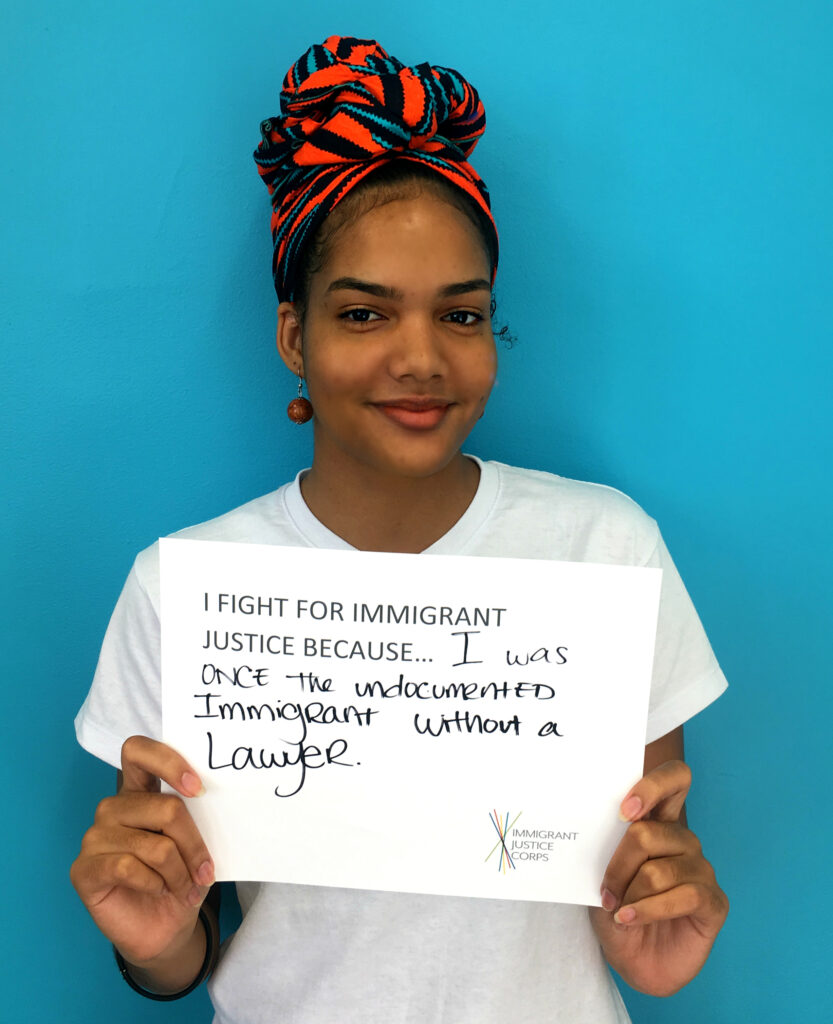
Reflections on the fellowship - Allison Baal

Our 2024 Justice Fellows and third-year 2023 Fellows are finishing their fellowships, wrapping up a term marked by changing policy, funding cuts, and an unprecedented assault on immigrant rights.
These Fellows have showed up, day after day, to support their clients.
Allison Baal, a 2024 Justice Fellow working at Lutheran Social Services, writes about the importance of collaboration in immigration work. Allison is a graduate of Touro University Jacob D. Fuchsberg Law Center.
Entering the field as a newly minted immigration attorney in New York City at a time during so much change and upheaval has been a challenge to say the least. I was just four months into my fellowship when the administration changed, and, along with it, seemingly every component of immigration law. Our advice to clients was changing from day to day. A strategy that was successful one week became obsolete the next. Trying to learn how to practice in a system that was becoming increasingly convoluted proved to be a unique challenge. I quickly discovered, however, that I was far from alone. The more that I learned, the more that I realized that everyone in this space—even seasoned immigration attorneys—were grappling with identifying the most effective case strategies, advising clients, and trying to make sense of the ever-changing legal landscape. Each of us, however, had the same goal—to provide effective representation and support to our clients.
As I look back on my fellowship, with my two years nearly complete, one thing that really stood out to me was the collaboration of this community. Despite all the new hardships, wins still came. This was in large part because Fellows and other attorneys were willing to share their experiences, share what worked for their client, and oftentimes go out of their way to help someone else. Success can’t be achieved in a vacuum: I quickly learned that the best way to fight against an increasingly hostile system was to band together to strategize and share best practices. We truly are all in this together.
This collaboration deeply impacted my experience as an IJC Fellow. When I prepared for an asylum hearing in immigration court, a former IJC Fellow gave our team guidance about best practices in an increasingly hostile environment. When I needed guidance on getting a Special Immigrant Juvenile Status (SIJS) recipient his green card in a complicated case, IJC staff members gave suggestions during office hours. When I was faced with a roadblock in getting my unaccompanied child client’s case terminated in immigration court so that he could pursue relief elsewhere, I emailed a listserv of immigration attorneys and received advice from those encountering the same issue. When I needed to know how a recent lawsuit affected my client’s case, an Immigrant Legal Resource Center (ILRC) update webinar provided me with answers. When I was working with a family who were members of a class-action lawsuit, the American Civil Liberties Union (ACLU) provided me with advice as I worked to ensure that the family stayed together.
My fellowship taught me that I am never alone in this work. IJC, and others, are always there to lend a hand. In the second year of this administration, the legal landscape continues to rapidly change. I have witnessed first-hand how the system is only getting more hostile towards immigrants. And, with that, IJC support continues to be more vital than ever to those entering the field for the first time. With this support, we ensure that the immigrant community we serve can face the system with a well-equipped, passionate attorney by their side.