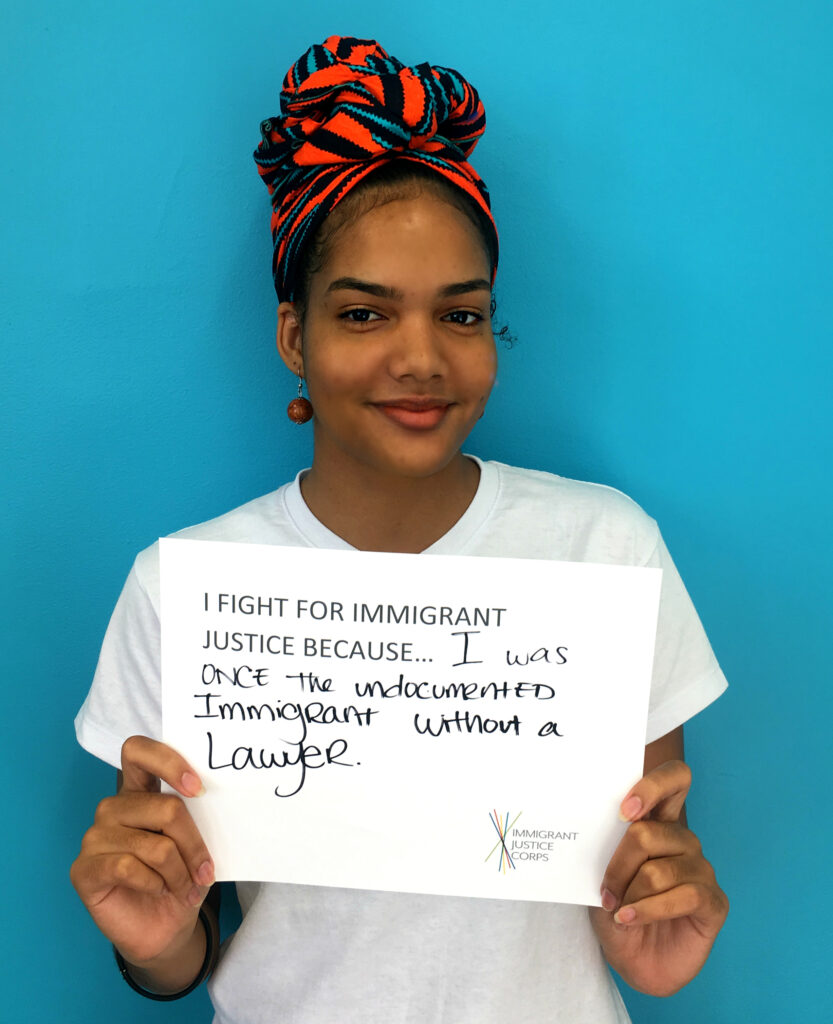
Reflections on the fellowship - Cedar Weyker

Our 2024 Justice Fellows and third-year 2023 Fellows are finishing their fellowships, wrapping up a term marked by changing policy, funding cuts, and an unprecedented assault on immigrant rights.
These Fellows have showed up, day after day, to support their clients.
Cedar Weyker, a 2023 Justice Fellow working at The Advocates for Human Rights, describes her experience with boundary setting and how difficult it can be when working in the immigration field. Cedar is a graduate of University of Minnesota Law School.
My third-year fellowship has been a learning opportunity in more ways than one. I am working with many of the same clients and taking the same types of cases, but this year I am learning more about myself. Specifically, what are my limits and what do I do when I’ve reached them?
Before I started my fellowship, people told me that immigration law was a difficult field. I knew that this practice was legally complex and ever-changing. I knew that working at a nonprofit brings its own challenges. But my job has never been as stressful or demanding as it has been this past year. Most of these stressors have nothing to do with my host organization, my clients, or the topics I deal with. My stress comes from a prolonged federal occupation, a tidal wave of dehumanizing legal precedent, secondhand trauma, and a feeling of helplessness.
Everyone warns us that we must take care of our mental health and practice self-care. Actually learning how to do it takes time, and, in my case, Trump 2.0. Law school doesn’t teach you how to turn off your brain after another devastating workday blow. But I have learned valuable lessons from colleagues at my host organization and members of my local legal community this year.
I sometimes have a problem with doing too much. I agree to take on too many projects, try to connect my clients with additional resources, and sometimes work later than I should.
During Operation Metro Surge, I felt overwhelmed by the amount of work that needed to get done and the number of people who needed help. Self-doubt plagued me whenever I had a moment to think: if I make a mistake, will this person get deported? How likely is it that this will backfire and ruin their life? Do I have any idea what I’m doing? Could I be doing more? At the same time, my body was asking me other questions: why haven’t you eaten since 9 am? Why haven’t you gone to bed yet? How long are you going to think about something you have no control over?
As my coworkers and I tried to work under mounting pressure, we stopped taking care of ourselves, and it showed. Coworkers fell ill and tried to work through it, making things worse. Some attorneys in my local AILA chapter quit or retired. Community members praised us and told us how important our work was, but we were falling apart.
When it felt like the only thing left to do, I actively began to focus on myself. I made time for friends and family. I made myself as many chai lattes as I wanted. I started saying “no” more often. I cried. I stopped expecting myself to do anything after work that I didn’t want to do. It didn’t fix things, but it helped. (Turns out my mom was right all along about everything)
Being a good attorney means setting good boundaries. I am grateful to my coworkers and supervisors for helping me navigate the past few months as I try to figure out what that means for me.