Community Fellowship
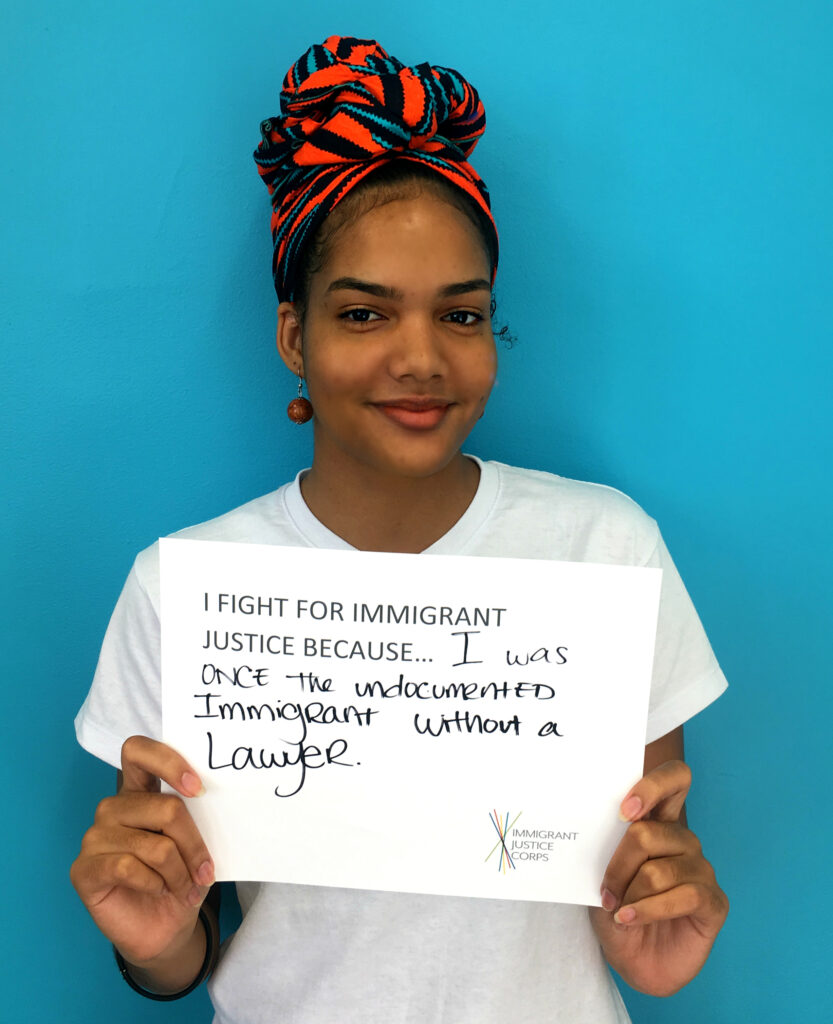
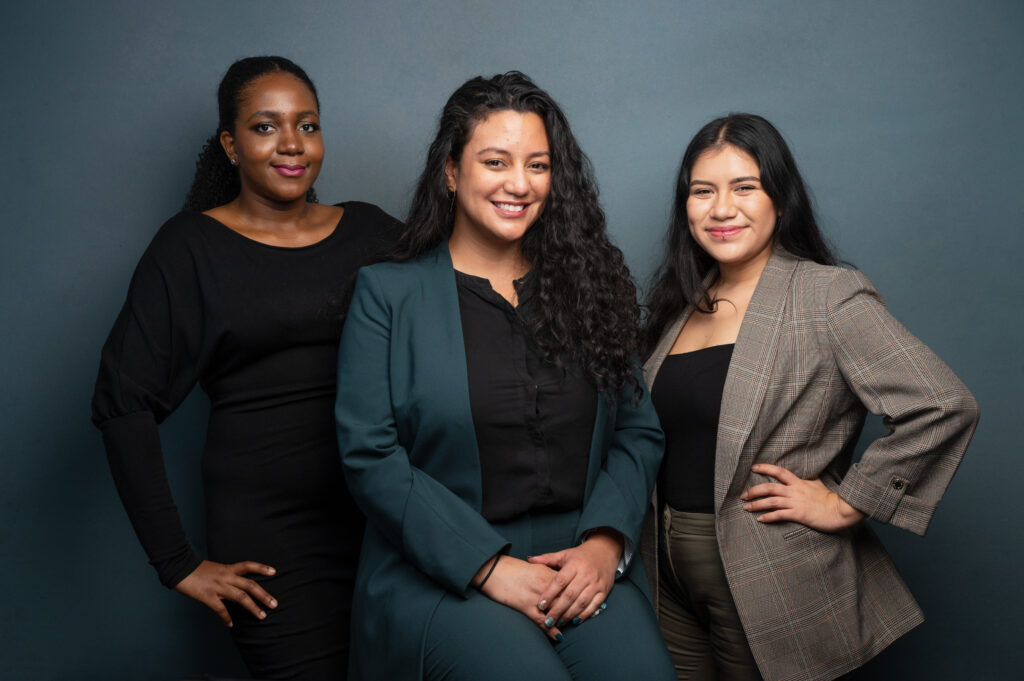
Three-year Community Fellowships are awarded to recent college graduates with the language skills, passion, and cultural competency to work with diverse immigrant communities.
Defining our future.
Defending what’s right.
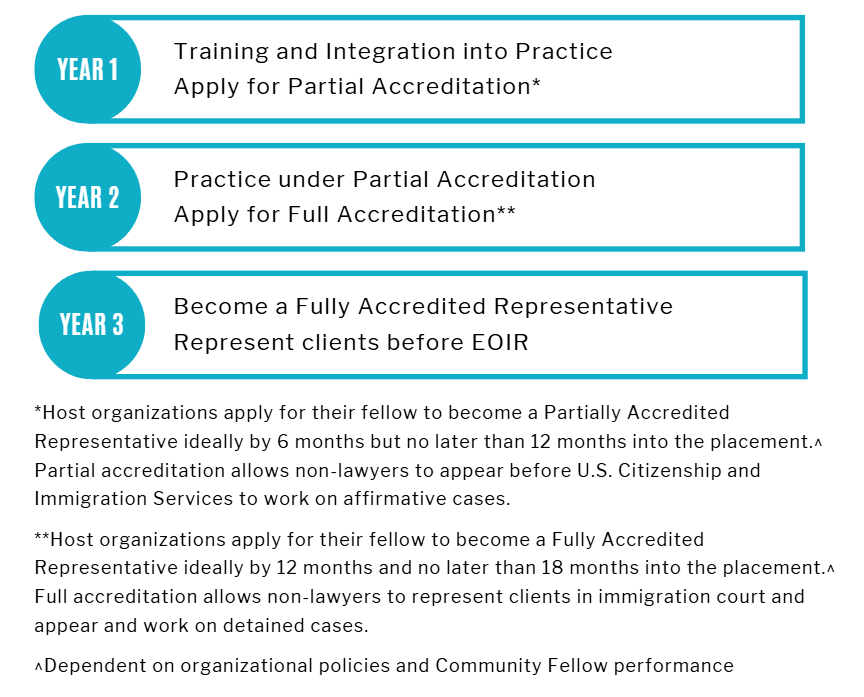
IJC’s 2026 Community Fellows will be inaugural three-year placements awarded to recent college graduates with the linguistic skills, passion, and cultural competency to work with diverse immigrant communities. IJC seeks to foster advocates who seek to achieve full accreditation from the Department of Justice’s Recognition & Accreditation Program by the end of the fellowship.
Community Fellows will seek partial accreditation by the end of year 1 (ideally by 6 months and no later than 12 months) of the placement, which allows them to practice before U.S. Citizenship & Immigration Services and ideally achieve full accreditation by the midpoint of the placement (between 12 months to 18 months) to allow Fellows to gain experience before the Immigration Courts. IJC Fellows are granted full salary and benefits.
Community Fellows carry their own caseloads and provide a broad range of representation, under the supervision of legal staff at their host organization.
Become a
Community Fellow

Immigrant Justice Corps seeks Fellows who are smart, compassionate, and passionate about justice for immigrants. Fellows must be dedicated to the idea of a fellowship program – you dedicate three years of hard work, we ensure you are fluent in immigration law and are trained to represent immigrants who cannot afford quality representation.
Eligibility
- Applicants may currently be enrolled in an undergraduate degree, with expected graduation by the Spring of the Fellowship start year. For example, if you are graduating in Spring 2026 you will be eligible to apply to the Class of 2026.
- Applicants may have graduated from college no more than two years prior to the start of the Fellowship. For example, if you are applying to the Class of 2026, you must have graduated college no earlier than Spring 2024.
- All Fellows must be eligible for work authorization in the U.S. for the full three years of the Fellowship placement. Applicants with DACA or TPS are welcome to apply.
- All Fellows must be proficient in a second language in addition to English, with Spanish (including indigenous dialects) preferred for the Class of 2026.
Application timeline and common questions about the Community Fellowships.
Learn about the experience and work of this year’s Fellows.
Learn about our partners and potential placements.

Our Matching Process
Unlike other Fellowships, IJC recruits both Fellows and host organizations.
IJC matches selected Fellows with our partnering host organizations based on the applicant’s experience and interest, gaps in services within the community, location preferences, and partnering host organizations’ needs.

IJC welcomes 2026 Community Fellows!
The Fellows will be inaugural three-year placements, who will seek to achieve full accreditation from the Department of Justice’s Recognition & Accreditation Program.
What sets IJC apart?
Building Community
Each IJC Fellow forms a crucial link in an expansive web of advocates across the country. When you join IJC, you become connected to your cohort, our staff, alumni, and host organizations.
Right to Counsel
The very existence of IJC has raised awareness of both the crisis of representation and the dramatic difference representation makes in immigration cases. Through our fellowship programs, IJC seeks to close the gap in access to representation and move the needle toward a universal right to counsel for all immigrants. As a Fellow, you will be a part of that effort to ensure every immigrant in the United States has access to quality counsel.
Training & Skills Development
IJC offers high quality, on-going training and skills development. Fellows foster lifelong professional connections during the program and build skills they will draw on for the remainder of their career as an immigration advocate.
Expanding Capacity
IJC focuses on efficiently increasing representation by placing Fellows with host organizations that are leading non-profit legal services providers and community-based organizations.
Creating Access to Justice
IJC expands access to justice for underrepresented communities while advocating quality representation for these populations.